Simple double-loop TEG: Difference between revisions
imported>KindaNice |
Added Imported Page template |
||
| Line 1: | Line 1: | ||
{{Imported Page}} | |||
This guide was originally written by [[User:Soupki]] in October 2024 in the [[Power]] page. | This guide was originally written by [[User:Soupki]] in October 2024 in the [[Power]] page. | ||
Latest revision as of 09:33, 31 October 2026
This guide was originally written by User:Soupki in October 2024 in the Power page.
To create this TEG setup you don't need any active knowledge of what's going on. However, I highly recommend you have knowledge of what all of the pieces do so that you can test and make modifications of your own.
Selecting the right pumps
The most important lesson is why we would use one type of pump over another.
- Gas pumps will continue to operate until 4500 kPa is reached within the output pipe network regardless of the volume.
- Volumetric gas pumps will continue to operate until 200 Liters is reached in all of the pipes within the output pipe network regardless of pressure.
If you were to pump both a gas pump and a volumetric gas pump into an empty network they would transfer at equivalent speeds of 1 L/s to 45 kPa. (This is just based off of testing and is as accurate as my eyes could perceive, so it's likely not mathematically accurate. It's close enough to be accurate in the vast majority of applications from what I've found.)
This difference is highly important when considering what pump to use. For example, in high heat networks volumetric gas pumps are preferred because they do not care about the pressure created by the heat and only care about the volume within the network. Volumetric pipes are also good at providing a means of storage because they will fill a network based on volume rather than pressure. We can use this to our advantage in a multitude of places including replacing gas miner pumps to be volumetric so that they do not idle.

The Burn Chamber
Gas mix
The pre-mix is important to sustaining a long term TEG. Canisters are nice in ease of use but will rapidly drain and require you to pay attention to when it needs a refill.
- The mix we will be using for this setup is 96% oxygen and 4% plasma. (Note, anything above 3% plasma will hit supersaturation as per comments on line 41)<ref>https://github.com/space-wizards/space-station-14/blob/master/Content.Server/Atmos/Reactions/PlasmaFireReaction.cs#L41</ref>
- In the screenshot below, the Primary port refers to Template:Tooltip. The side port refers to Template:Tooltip.

Construct the burn chamber
This is a controversial one. My reasoning for choosing a handmade burn chamber over the pre-mapped ones is that the pre-mapped burn chambers tend to be in awkward spots, easy to sabotage, takes longer to setup. I find that TEG is not only about power output but how fast you can deliver that power output. If setting up TEG takes an extra 5-10 minutes compared to making your own burn chamber, then in my opinion, it is not worth the effort. Additionally due to recent patches reinforced glass can be directly upgraded by just clicking on it with Plasteel in hand. Plasma glass also got a 16x strength nerf, making it the same strength as normal glass. This makes the shuttle glass setup to be significantly more resistant to breaking.
- Make sure that you turn on the volumetric pump and set it to 20 L/s before proceeding. It's also important to turn off the air injector and close the valve to prevent any accidental leaks of plasma mix into the ambient room.
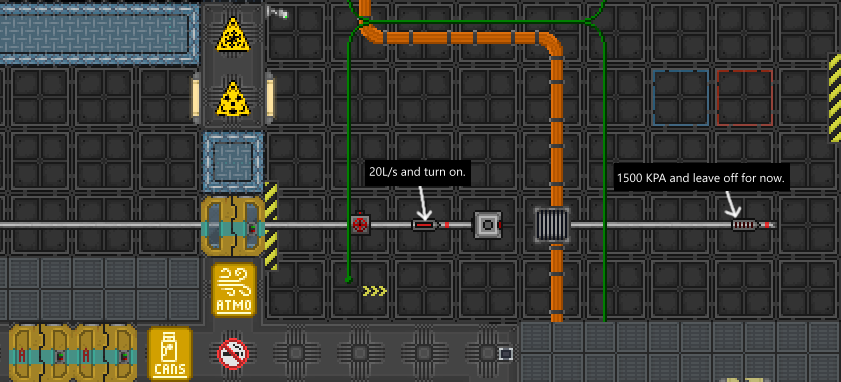
- Add the reinforced glass with the RCD after you have turned on the volumetric gas pump.
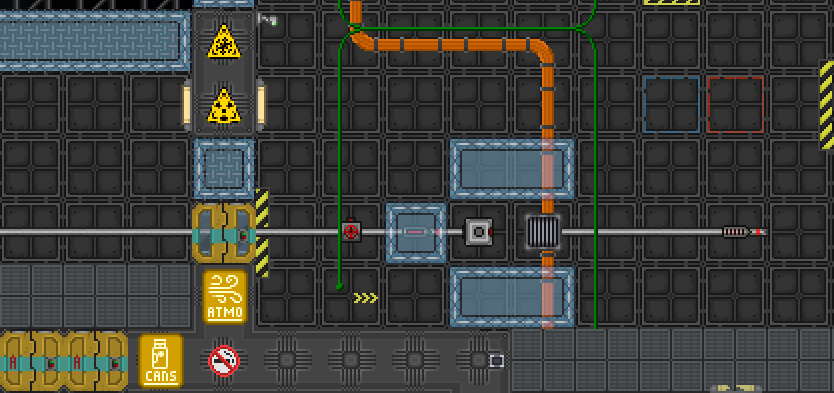


Building the Hot Loop
The hot loop is half of the setup and providing it with sufficiently hot temperatures and thus pressure is key to producing a high amount of steady energy.
- Real simple loop. One volumetric gas pump before the TEG aids in providing movement to the gas within the network. Technically the TEG does not care what direction the gas is flowing. However, it is critical to keep in mind that if you pump gas on the hop loop in one direction, you must pump the cold loop in the opposite direction. If you do not provide opposite flows between the loops the TEG will not function properly.
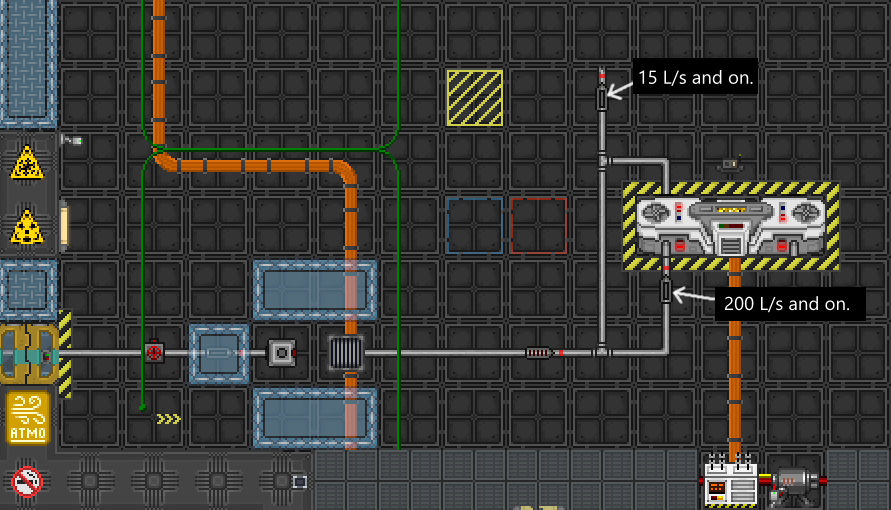
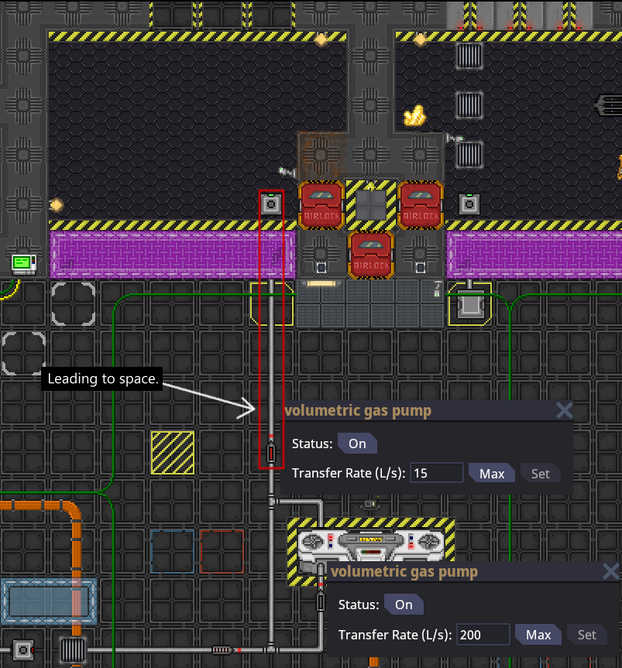
- A secondary key importance to the hot loop is leaking volume from the loop. This is important because it prevents volumetric lockout so it aids in keeping the hot gas flowing in a loop which is what we want.


The Cold Loop
The cold loop is really simple to setup. The logic behind the cold loop is a bit more complicated though. Essentially we want it to be as cold as possible without losing pressure as pressure plays a vital role in energy production - see Pressure and Moles. This is why I have found that using a single spaced radiator is both the most time efficient and does not compromise the pressure. It may scare some more experienced atmosians to try this out but I encourage you to try it. Extensive testing has shown this cold loop prefers to be between 100C to 400C which typically ends up being ~4k kPa.
- The build is simple here but the most important factor is to use a plasma canister over any other. This is because plasma is more thermo-conductive than other gasses. This leads to usually a gain in 20kw of power just for using plasma canister over other canisters.
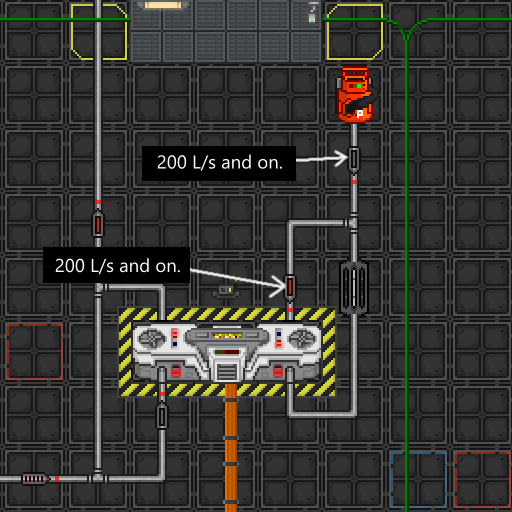
- Now we make a horseshoe shape around the radiator with directional reinforced windows using your RCD. Put a gas trap by placing a holo-projected firelock with your holographic projector.
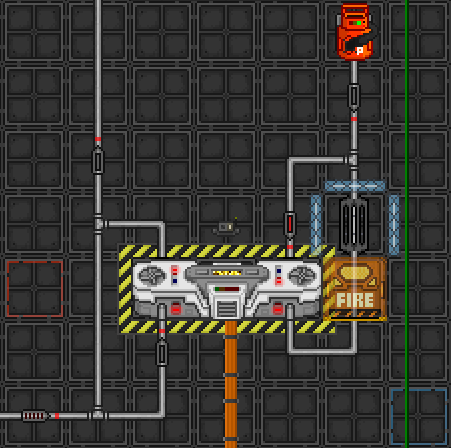
- Space the floor tile below the radiator and then close the box of directional reinforced windows. (Both using your RCD)
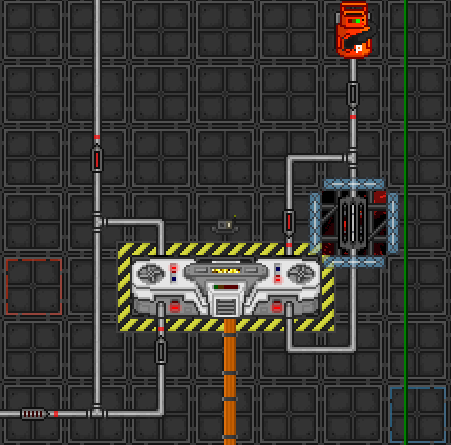


Finishing the Hot-Loop
It's time to finish the hot loop now that we have everything else setup.
- Place a holographic firelock on the empty space of the "rectangle" burn chamber we created earlier. Then light a flare or a welder and place it on top of the passive vent. Make sure to turn on the air injector and valve at this point. To do so click on them to make them to have a green indicator on their "light".
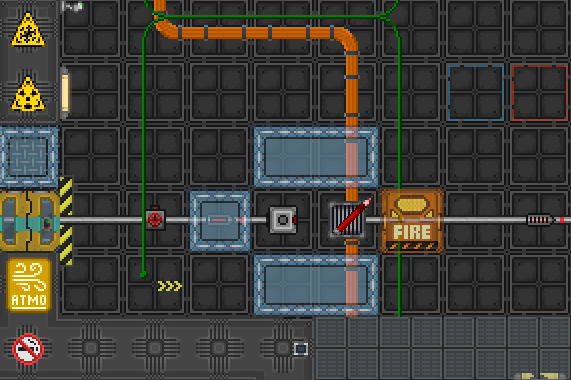
- Make sure that the air injector and the valve are on and the fire is starting to burn. Close the box with another reinforced window where the holographic airlock is.
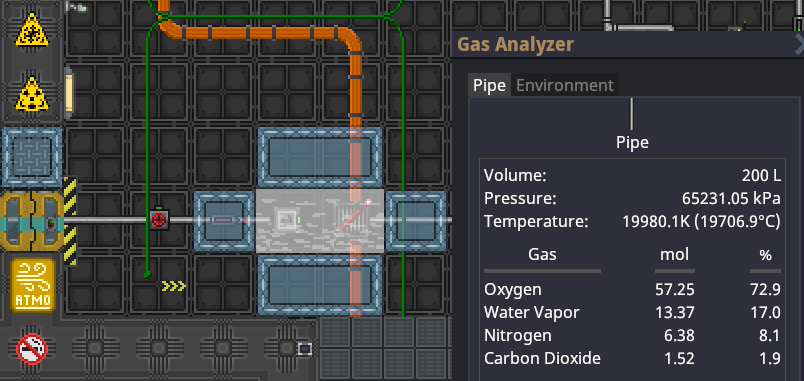
- Use a gas analyzer on the pipe that's coming out of the output of the burn chamber. Wait until it is ~20,000C. Turn on the gas pump at 1500 kPa. This pump controls your power output maximum.
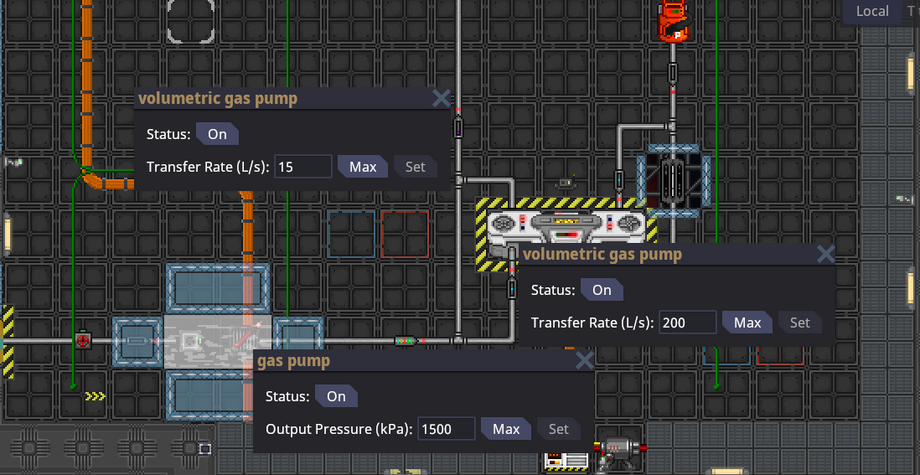
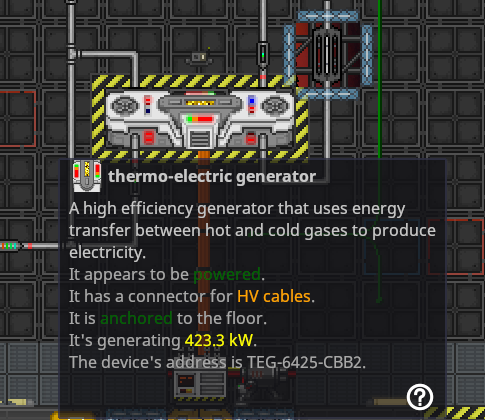
- 1500kPa on the gas pump produces at a maximum ~420kW of power.


Final thought / Full build
This build is capable of a maximum output of 1.4 MW of power at 4500 kPa of pressure on the gas pump.

This is the completed TEG image for quick reference.

FAQ
- I followed all the steps but my TEG doesn't produce any power, why's that?
- Make sure both of your gas loops are pressurized, and that you aren't relying on any pressure-locked pumps to move gas into the TEG.
- Make sure that the direction of the pumps on your gas loops matches the direction seen when examining the end pieces of the TEG.
- My TEG is not producing much power, why's that?
- The TEG only produces power to meet demand, even if it's able to produce more power. If you look on the power generation console in engineering, you will only see the power that the TEG is currently providing will always lower than that (and will be significantly lower if you have other sources of power). Examining the central TEG piece now shows both the current power generation and theoretical maximum power generation, so make sure you're looking at that theoretical maximum to evaluate performance.
- I messed up the gas chamber really bad how do I fix it?
- Don't worry it's an easy fix with this setup.
- Just turn off the valve inputting into the burn chamber and max out the output of the gas pump coming out of the burn chamber.
- You should also max out the volumetric gas pump coming out of the hot loop that's going into space.
- This should empty your burn chamber without any major fixes. Check if the burn chamber is empty (use a gas analyzer on the output pipe).
- When the burn chamber is empty fix the problem that broke the burn chamber, turn off the gas pump that's coming out of the output of the burn chamber, and then ignite a new flare/welder on top of the passive vent again.
- Close the burn chamber and then turn on the valve on the input side of the burn chamber, wait for 20,000C and turn on the output gas pump.